

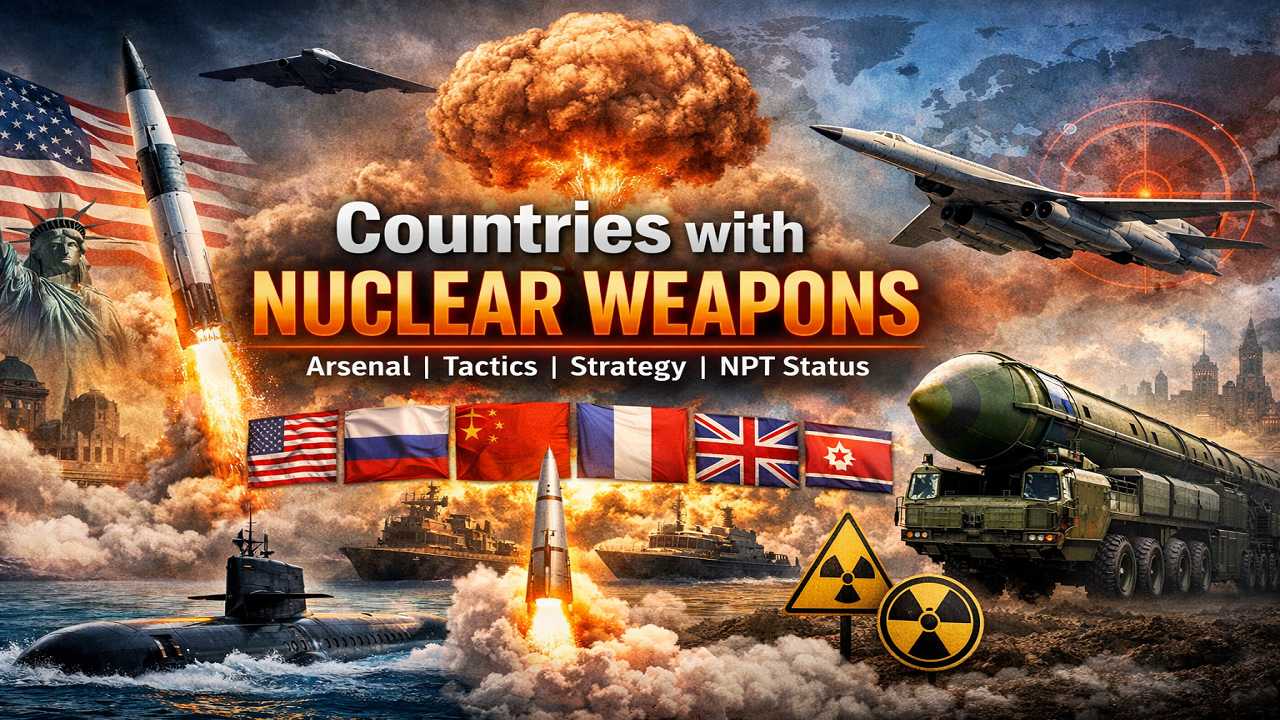
As of 2026, nine countries possess nuclear weapons: the United States, Russia, China, France, the United Kingdom, India, Pakistan, Israel, and North Korea .
Together, they hold roughly 12,000+ nuclear warheads, with the vast majority controlled by the United States and Russia alone .
These states can be divided into:
- NPT-recognized nuclear powers (P5): US, Russia, China, France, UK
- Non-NPT nuclear states: India, Pakistan, Israel
- Withdrawn from NPT: North Korea
⚙️ Understanding Nuclear Arsenal Structure
Before diving into each country, it’s important to understand how nuclear arsenals are structured.
1. Strategic vs Tactical Weapons
- Strategic nuclear weapons target cities, infrastructure, and large-scale military assets.
- Tactical nuclear weapons are designed for battlefield use and shorter-range targets .
2. The Nuclear Triad
Most advanced nuclear powers rely on the nuclear triad, consisting of:
- Land-based missiles (ICBMs)
- Submarine-launched missiles (SLBMs)
- Strategic bombers
This triad ensures second-strike capability, making deterrence credible.

United States
Arsenal Structure
- ~5,000+ warheads (active + reserve)
- Mix of deployed, reserve, and retired weapons
Tactical Nuclear Weapons
- ~200 tactical warheads
- ~100 deployed in Europe under NATO nuclear sharing
Delivery Systems
- Full nuclear triad:
- Minuteman III ICBMs
- Trident II SLBMs (submarines)
- B-52 & B-2 bombers
Strategy
- Deterrence + extended deterrence (nuclear umbrella)
- Maintains readiness for both strategic and limited nuclear conflict
Storage
- Missile silos (Great Plains)
- Submarine bases
- Air force bases (domestic + Europe)
NPT Status
- ✅ Recognized Nuclear Weapon State (NWS)
Russia
Arsenal Structure
- ~5,500+ warheads (largest globally)
Tactical Nuclear Weapons
- ~1,900 tactical warheads (largest stockpile)
- Includes diverse systems (even naval and air-defense nuclear weapons)
Delivery Systems
- Full triad:
- ICBMs (Sarmat, Yars)
- SLBMs (Borei submarines)
- Strategic bombers (Tu-95, Tu-160)
Strategy
- Escalate to de-escalate doctrine
- Allows limited nuclear use to end conflicts on favorable terms
Storage
- Centralized storage + forward deployment (e.g., Belarus)
NPT Status
- ✅ Recognized NWS

China
Arsenal Structure
- ~600+ warheads, rapidly expanding
Tactical Nuclear Weapons
- Limited but evolving
- Focus remains on strategic deterrence
Delivery Systems
- Developing full triad:
- DF-series ICBMs
- JL-series SLBMs
- H-6 bombers
Strategy
- No First Use (NFU) policy
- Minimum deterrence, but expanding toward parity
Storage
- Warheads often stored separately from missiles
- Underground facilities (e.g., Shaanxi region)
NPT Status
- ✅ Recognized NWS
France
Arsenal Structure
- ~290 warheads
Tactical Nuclear Weapons
- No dedicated tactical arsenal (primarily strategic)
Delivery Systems
- Dual-based:
- Submarine-launched missiles
- Air-launched cruise missiles
Strategy
- Independent deterrence (“force de frappe”)
- Focus on national sovereignty
Storage
- Centralized military bases and submarine fleets
NPT Status
- ✅ Recognized NWS
United Kingdom
Arsenal Structure
- ~225 warheads
Tactical Nuclear Weapons
- Historically removed tactical systems
- Relies mainly on strategic weapons
Delivery Systems
- Single-leg deterrent:
- Trident SLBMs on submarines
Strategy
- Continuous At-Sea Deterrence (CASD)
Storage
- Warheads stored domestically; deployed via submarines
NPT Status
- ✅ Recognized NWS
India
Arsenal Structure
- ~160–170 warheads (estimated)
Tactical Nuclear Weapons
- Developing short-range systems (battlefield use potential)
Delivery Systems
- Emerging triad:
- Agni-series missiles
- Arihant-class submarines
- Aircraft delivery
Strategy
- No First Use policy
- Credible minimum deterrence
Storage
- Likely centralized, with warheads de-mated from delivery systems
NPT Status
- ❌ Not a signatory
Pakistan
Arsenal Structure
- ~170–180 warheads
Tactical Nuclear Weapons
- Strong emphasis (e.g., Nasr short-range missiles)
Delivery Systems
- Land-based missiles + aircraft
- Developing sea-based deterrent
Strategy
- Full-spectrum deterrence
- Designed to counter India at all conflict levels
Storage
- Dispersed and mobile storage systems
NPT Status
- ❌ Not a signatory
Israel
Arsenal Structure
- Estimated ~90 warheads (opaque policy)
Tactical Nuclear Weapons
- Possible development (including neutron bombs)
Delivery Systems
- Likely full triad:
- Jericho ballistic missiles
- Submarine-launched cruise missiles
- Aircraft
Strategy
- Nuclear ambiguity (opacity doctrine)
- Neither confirms nor denies arsenal
Storage
- Highly secretive; believed dispersed and hardened
NPT Status
- ❌ Not a signatory
North Korea
Arsenal Structure
- Estimated 40–90 warheads (growing)
Tactical Nuclear Weapons
- Developing tactical nuclear capabilities
Delivery Systems
- Ballistic missiles (short to intercontinental range)
Strategy
- Regime survival + coercive deterrence
Storage
- Underground facilities and mobile launchers
NPT Status
- ❌ Withdrew from NPT (2003)
📊 Comparative Summary
| Country | Arsenal Size | Tactical Nukes | Delivery System | Strategy | NPT Status |
|---|---|---|---|---|---|
| USA | ~5,000 | Yes | Triad | Global deterrence | Yes |
| Russia | ~5,500 | Extensive | Triad | Escalate-to-de-escalate | Yes |
| China | ~600+ | Limited | Expanding triad | No First Use | Yes |
| France | ~290 | No | Air + Sea | Independent deterrence | Yes |
| UK | ~225 | No | Sea only | Continuous deterrence | Yes |
| India | ~160 | Limited | Emerging triad | No First Use | No |
| Pakistan | ~170 | Yes | Land + Air | Full-spectrum deterrence | No |
| Israel | ~90 | Possible | Triad (suspected) | Ambiguity | No |
| North Korea | ~40–90 | Developing | Missile-based | Regime survival | Withdrew |

🧠 Key Takeaways
- Two countries dominate: The US and Russia hold over 80% of global nuclear weapons
- Tactical nuclear weapons are resurging, especially in Russia and Pakistan
- The nuclear triad remains the gold standard for credible deterrence
- NPT divides the world into recognized vs de facto nuclear powers
- Modernization is accelerating, raising concerns of a new arms race