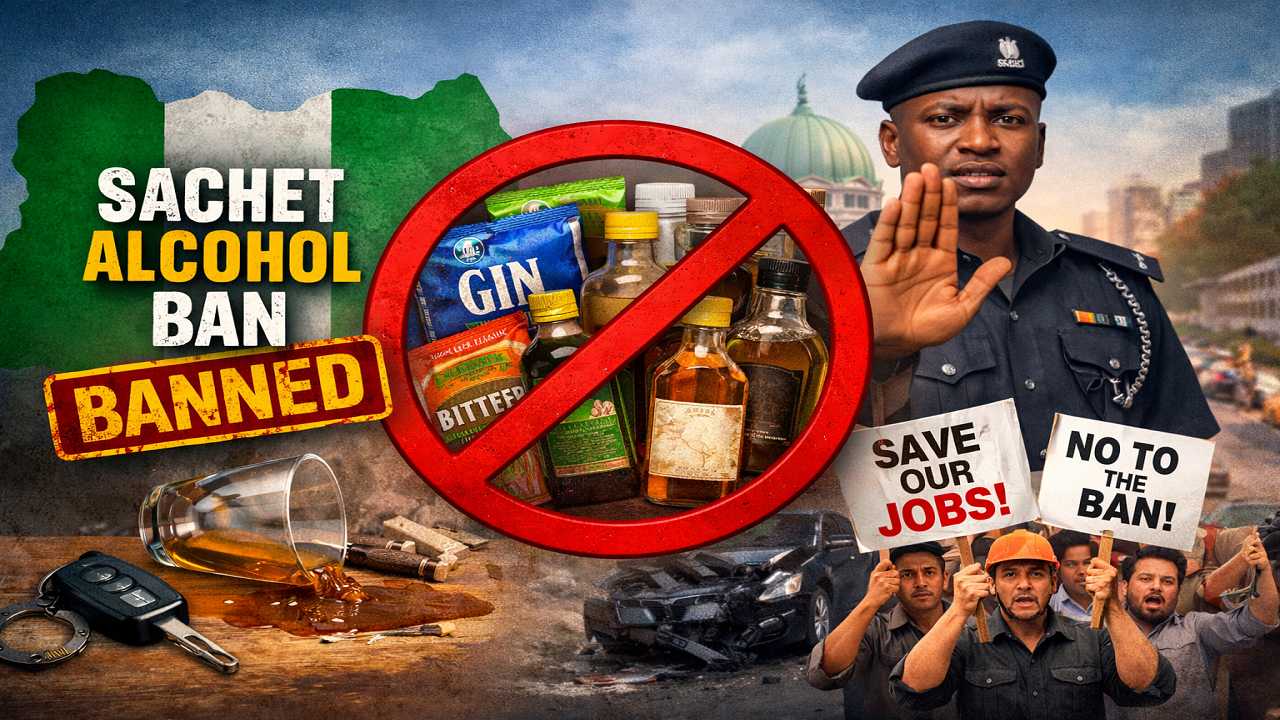
TT – In recent years, Nigeria has intensified efforts to regulate alcohol consumption — culminating in a nationwide ban on the production, sale, and distribution of alcoholic beverages packaged in sachets and small bottles (under 200ml). This move, driven primarily by public health concerns and legislative directives, has sparked national debate, protests, and economic concerns.
🧠 What Is the Sachet Alcohol Ban?
The sachet alcohol ban refers to a regulatory policy that prohibits the sale and production of alcoholic drinks packaged in small sachets or containers under 200ml. These include cheap spirits and herbal alcoholic beverages often sold in sachets or small PET bottles popular across informal markets in Nigeria.
Originally introduced by the National Agency for Food and Drug Administration and Control (NAFDAC), the policy aimed to restrict access to cheaply packaged alcohol that was widely consumed by youths and low-income Nigerians. After a phased-out period and a temporary suspension, full enforcement commenced in January 2026 following directives from the Nigerian Senate and federal authorities.
📜 Historical Background
The idea of regulating sachet alcohol is not new. In December 2018, a multi-stakeholder agreement — involving NAFDAC, the Federal Ministry of Health, beverage industry bodies, and regulatory agencies — set a five-year moratorium to phase out alcohol packaged in sachets and small bottles. By January 31, 2024, companies were meant to phase these products out.
However, enforcement was delayed multiple times as stakeholders negotiated implementation details and industry concerns. By late 2025, the Senate passed a resolution directing NAFDAC to enforce the ban without further extensions, leading to full implementation in early 2026.
🧬 Why Was Sachet Alcohol Banned?
⚕️ Public Health Concerns
NAFDAC has repeatedly stated that the primary reason for the ban is to protect public health — especially among young people and vulnerable populations. Sachet alcoholic drinks often contain high alcohol concentrations (around 30% ABV or higher) — far more potent than beer and other regulated beverages — making them more likely to contribute to misuse and addiction.
Officials also argued that the small packaging makes the drinks extremely accessible, cheap, and easy to conceal, contributing to a rise in consumption among minors and underage drinkers.
📉 Reducing Harm and Social Vices
Supporters of the ban point to the link between cheap alcoholic products and social problems such as:
- Underage drinking
- Addiction and substance misuse
- Domestic violence and crime
- Road traffic accidents
- School dropouts and reduced productivity
The Senate backing and public health advocates have framed the ban as part of a wider strategy to curb harmful behaviors tied to alcohol abuse among youths and broader society.
📊 Economic and Industry Pushback
While the ban is framed as a protective measure, it has drawn significant backlash from manufacturers, labor unions, and industry associations:
💼 Job Losses and Economic Impact
The Manufacturers Association of Nigeria (MAN) warns that the ban could cost the sector trillions of naira in investments and result in hundreds of thousands of job losses — both in direct manufacturing and informal distribution networks.
Estimates cited include:
- Losses of over N1.9 trillion in investment
- Potential retrenchment of 500,000+ direct workers
- Millions more affected indirectly across supply chains and informal markets
📉 Industry Arguments
Critics argue that:
- The ban unfairly targets packaging rather than actual consumption behavior.
- It could spur black market activities, adulterated products, and illegal imports.
- Existing labelling and age restrictions could be strengthened instead of outright prohibition.
🧾 Government Revenue Concerns
Economists have also warned that banning a popular category of alcohol could reduce tax revenue, as sachet alcohol contributed significantly through excise duties, levies, and informal market transactions.
🧑⚖️ Legal and Political Dimensions
The ban’s enforcement reflects complex governance dynamics:
- In 2025, some government offices temporarily suspended or reviewed enforcement timelines pending consultations.
- However, any temporary lifting expired by December 31, 2025, and the directive from the Senate ensured the ban would proceed.
- NAFDAC insists it has not closed any factories but is merely regulating packaging formats, not outrightly outlawing alcohol itself.
This push-pull between regulatory agencies, lawmakers, and economic stakeholders illustrates the political balancing act between health policy and economic interests.
🧠 Public Reaction and Civil Society
Public opinion on the ban is mixed:
👏 Supporters
Some civil society groups and health advocates praise the policy as a necessary measure to curb harmful drinking patterns — especially among youths and low-income consumers.
They argue that the ban sends a strong message prioritizing health over profit and aligns with international strategies to reduce alcohol-related harm.
👎 Opposition
Other groups, including consumer rights organizations, have threatened protests and legal action against what they describe as misrepresentation and unfair enforcement.
Labor unions and worker coalitions are also vocally opposing the ban for its potential to cost livelihoods and worsen unemployment.
⚖️ Balancing Public Health and Economic Realities
At its core, the sachet alcohol ban highlights a perennial tension in public policy:
- Protective regulation vs. economic freedom
- Public health vs. industry interests
- Social welfare vs. market priorities
While the government champions the ban as a necessary intervention to protect future generations, critics argue that other tools — such as education, taxation, enforcement of age restrictions, and responsible marketing — might offer more balanced paths forward.
📝 Conclusion
The ban on sachet alcohol in Nigeria represents a landmark shift in how the country approaches alcohol regulation, especially concerning youth protection and public health. Whether it will achieve its intended goals — or create unintended economic and social consequences — remains a central theme in ongoing debate.
Whatever the outcome, the policy underscores Nigeria’s struggle to navigate complex socio-economic challenges while attempting to prioritize the health and wellbeing of its citizens.