

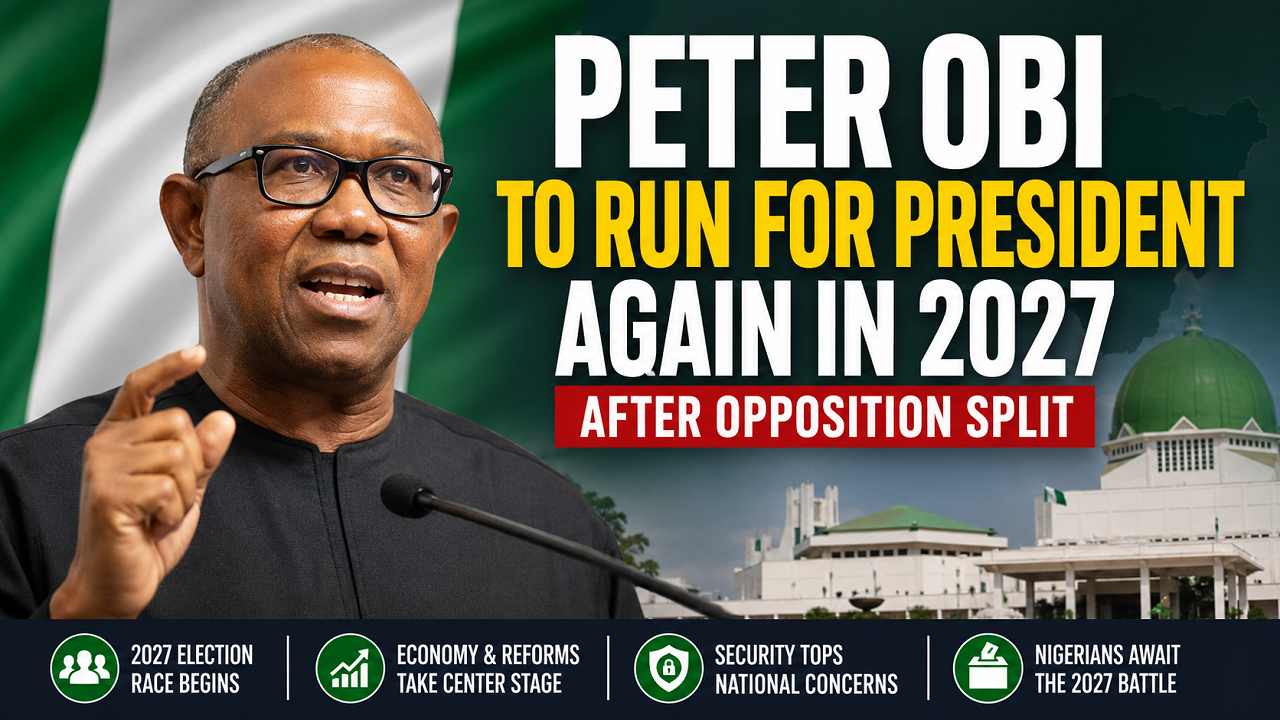
TT – The biggest political story in Nigeria this week is the official confirmation by Peter Obi that he will contest the 2027 presidential election. The announcement has immediately altered the country’s political calculations and officially launched what is expected to be one of the most fiercely contested elections in Nigeria’s democratic history.
For millions of Nigerians, Obi’s declaration is more than just another campaign announcement. It is the return of a politician who, in 2023, transformed Nigeria’s electoral landscape by mobilizing young voters, urban professionals, first-time voters, and citizens frustrated with traditional political structures. His decision to run again ensures that the debate over Nigeria’s economic future, governance reforms, and security challenges will dominate national discourse for months ahead.
How We Got Here
The road to Obi’s 2027 declaration has been filled with political realignments and coalition negotiations.
Following the 2023 presidential election, opposition politicians spent months attempting to build a united front capable of challenging incumbent President Bola Ahmed Tinubu. The goal was straightforward: avoid the vote-splitting that many analysts believe contributed to Tinubu’s victory in 2023.
Earlier this year, several opposition figures attempted to form a broad coalition under a common platform. However, disagreements over leadership, candidate selection, internal party disputes, and political ambitions eventually weakened the alliance. Obi ultimately left the coalition and joined the Nigeria Democratic Congress (NDC), where he emerged as the party’s presidential nominee.
His victory in the NDC primary formally cleared the path for another presidential run.

Why Obi’s Announcement Is a Major Political Event
This announcement is significant because Obi remains one of Nigeria’s most influential opposition figures.
During the 2023 election, he built what became popularly known as the “Obidient Movement”—a political movement that attracted large numbers of young Nigerians, many of whom had never actively participated in politics before. His campaign relied heavily on social media, grassroots organizing, and messages centered on accountability and economic reform.
Unlike traditional political campaigns that often depend on powerful political godfathers and regional structures, Obi’s support base emerged largely from ordinary citizens seeking change in governance. Although he finished third in the official results, his influence on Nigerian politics was undeniable and permanently altered electoral conversations.
His return therefore signals that the issues that energized voters in 2023 remain unresolved.
The Economic Background Driving the Election
Perhaps the most important factor shaping the 2027 race is Nigeria’s economy.
Since assuming office, President Tinubu’s administration has implemented several major economic reforms, including:
- Removal of fuel subsidies
- Removal of electricity subsidies
- Liberalization of foreign exchange markets
- Ending certain currency controls
- Fiscal restructuring efforts
Supporters of these reforms argue they were necessary to stabilize the economy, attract investment, and address long-standing distortions in government finances. The administration maintains that difficult reforms today will produce long-term economic benefits.
However, many Nigerians have experienced the immediate consequences of these policies through:
- Higher transportation costs
- Rising food prices
- Increased fuel costs
- Inflationary pressure
- Reduced purchasing power
- Growing pressure on household incomes
As a result, economic hardship is expected to become the defining issue of the 2027 election. Obi is likely to position himself as an alternative economic manager capable of reducing waste, encouraging production, and restoring confidence in government institutions.
Security: Another Major Campaign Issue
Beyond economic concerns, insecurity remains one of Nigeria’s biggest challenges.
In his declaration, Obi emphasized the need to urgently tackle insecurity across the country. His comments reflect widespread public concern about violence affecting multiple regions.
Nigeria currently faces several security threats:
Northeast
The region continues to deal with insurgent activities linked to groups such as Boko Haram and Islamic State West Africa Province.
Northwest
Bandit groups continue to carry out kidnappings, village attacks, and ransom operations affecting thousands of residents.
North-Central Region
Communal conflicts involving land disputes, grazing routes, and ethnic tensions remain significant concerns.
Southern States
Criminal activities, separatist tensions, and attacks on infrastructure continue to present challenges to law enforcement agencies.
Security policy is therefore expected to become one of the central battlegrounds of the campaign.
The Challenge of a Divided Opposition
One of the most critical questions facing Obi’s campaign is whether opposition forces can avoid repeating the mistakes of 2023.
Political analysts have long argued that Nigeria’s opposition struggles because multiple candidates often compete for similar voter groups. When opposition votes are fragmented, the ruling party benefits.
The latest developments suggest that several major opposition figures may again run separately rather than unite behind a single candidate.
Among them is Atiku Abubakar, who has secured the nomination of another opposition platform and is reportedly preparing for what would be his seventh presidential bid.
If multiple major opposition candidates remain in the race, President Tinubu could once again benefit from a divided opposition vote.

Tinubu’s Advantages Going Into 2027
Despite public frustration over economic hardship, the incumbent enters the race with several significant advantages.
Incumbency
Historically, incumbents in Nigeria enjoy substantial political advantages, including visibility, institutional influence, and established national networks.
Party Structure
The ruling All Progressives Congress maintains one of the strongest political organizations in the country, with extensive structures across states and local governments.
Access to Government Performance Narrative
The administration can campaign on reforms it argues have stabilized Nigeria’s finances and improved investor confidence despite short-term hardship.
These factors make the race considerably more complex than a simple referendum on economic conditions.
What Obi Must Do to Win
For Obi to succeed in 2027, analysts believe several conditions would need to align:
Expand Beyond His Core Base
His strong support among young and urban voters must translate into broader support across rural communities and all geopolitical zones.
Build Stronger Political Structures
Grassroots enthusiasm alone may not be enough. Effective state and local political organizations will be crucial.
Convert Economic Frustration Into Votes
Public dissatisfaction does not automatically translate into electoral victory. Campaign organization and voter turnout will be decisive.
Appeal Across Regional and Religious Divides
Nigeria’s elections are heavily influenced by regional and demographic considerations. Successful candidates typically build broad national coalitions.
What Happens Next?
With Obi’s declaration now official, Nigeria’s political season has effectively begun.
Over the coming months, attention will focus on:
- Campaign strategies
- Possible political alliances
- Candidate selection processes
- Economic performance under the Tinubu administration
- Security developments across the country
- Voter registration and mobilization efforts
The 2027 election is increasingly shaping up as a referendum on two competing visions: whether Nigerians should continue with Tinubu’s reform agenda or choose an alternative path represented by Obi and other opposition candidates.

Conclusion
Peter Obi’s decision to contest the 2027 presidential election is not merely a candidacy announcement—it is the opening chapter of what may become Nigeria’s most consequential political contest in years. With economic hardship, insecurity, unemployment, and governance reforms dominating public discussions, the election will likely test whether Nigerians are prepared to continue with the current administration’s policies or embrace a different direction.
For now, one thing is certain: the race for Aso Rock has officially begun, and the political battle ahead promises to reshape Nigeria’s future.