

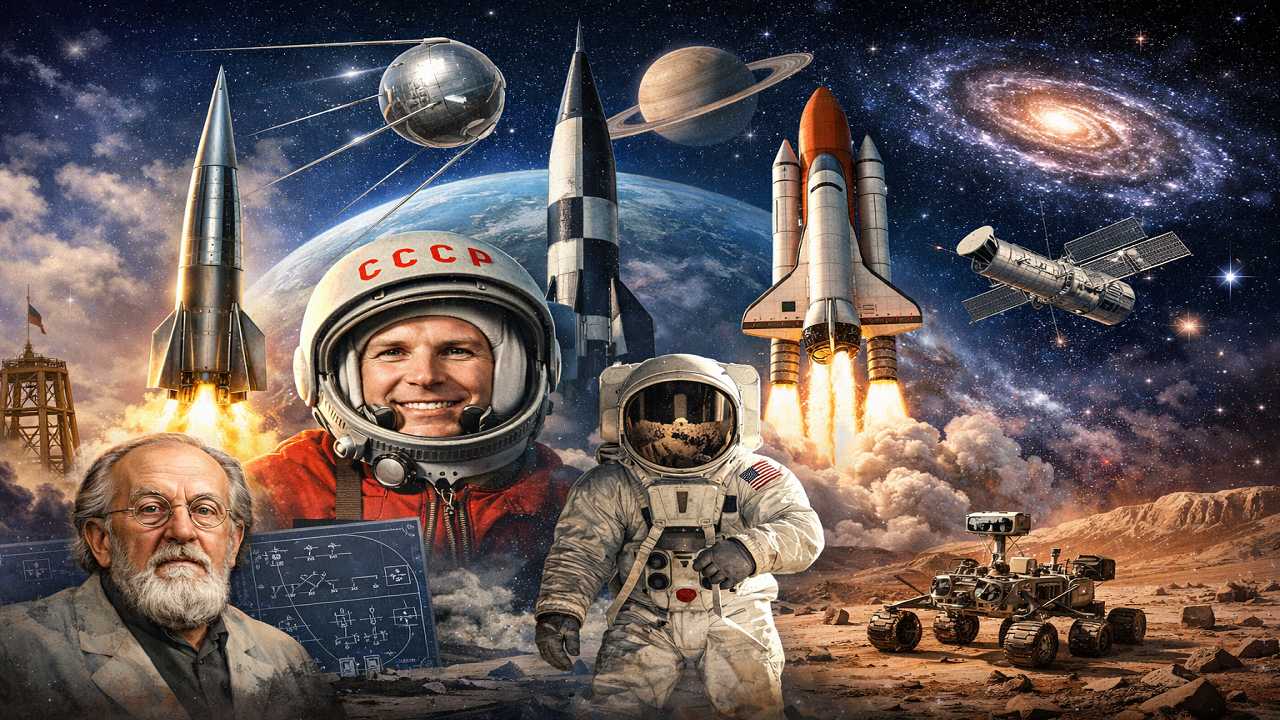
TT – For most of human history, the stars were symbols of mystery, mythology, and possibility. In just over a century, however, humanity transformed space from a distant curiosity into a realm of exploration. This is the story of how rockets, rivalries, science, and ambition carried us beyond Earth.
1. Theoretical Foundations and Early Rocketry
Modern space exploration began not with astronauts, but with equations.
In the early 20th century, pioneers like Konstantin Tsiolkovsky, Robert H. Goddard, and Hermann Oberth developed the theoretical and experimental foundations of rocketry. Tsiolkovsky derived the rocket equation that made spaceflight mathematically possible. Goddard launched the first liquid-fueled rocket in 1926, demonstrating that controlled, high-altitude flight was achievable.
World War II accelerated rocket development, especially with Germany’s V-2 missile program. After the war, both the United States and the Soviet Union recruited German engineers and began advancing long-range rocket technology — setting the stage for the Space Race.

2. The Space Race Begins (1957–1969)
The Space Race officially began on October 4, 1957, when the Soviet Union launched Sputnik 1, the world’s first artificial satellite. The beeping sphere orbiting Earth shocked the United States and demonstrated Soviet technological superiority.
Just four years later, on April 12, 1961, Yuri Gagarin became the first human in space, completing a single orbit around Earth.
In response, the United States dramatically expanded its space efforts through NASA (established in 1958). President John F. Kennedy challenged the nation to land a man on the Moon before the end of the decade.
That goal was achieved on July 20, 1969, when Apollo 11 successfully landed astronauts on the Moon. Neil Armstrong became the first human to step onto its surface, followed by Buzz Aldrin. Armstrong’s words — “That’s one small step for man, one giant leap for mankind” — became one of the most famous quotes in history.
The Space Race had reached its symbolic peak.
3. From Competition to Cooperation (1970s–1990s)
After the Moon landings, space exploration shifted focus. Instead of racing, nations began collaborating.
In 1975, the Apollo-Soyuz Test Project marked the first joint U.S.–Soviet mission in space. Later, international partnerships led to the creation of the International Space Station (ISS), launched in 1998. The ISS became a symbol of global cooperation, involving NASA, Roscosmos, the European Space Agency, Japan, and Canada.
During this period, robotic exploration flourished. Space probes traveled to the outer planets, including Voyager 1, which continues to send data from interstellar space. In 1990, NASA launched the Hubble Space Telescope, revolutionizing astronomy with breathtaking images of distant galaxies.
However, space exploration also faced tragedy. The space shuttle program suffered devastating losses with Challenger in 1986 and Columbia in 2003. These events reshaped safety standards and reminded the world of the risks inherent in spaceflight.
4. The Rise of New Space Powers (2000s–2010s)
In the 21st century, space exploration expanded beyond the U.S. and Russia.
China emerged as a major space power through the China National Space Administration (CNSA). Its Shenzhou program launched taikonauts into orbit, and China later built its own modular space station, Tiangong.
Meanwhile, private companies began reshaping the industry. SpaceX pioneered reusable rocket technology, drastically reducing launch costs. Blue Origin entered the field with its own launch systems and lunar ambitions.
This commercialization marked a major shift: space was no longer exclusively the domain of superpower governments.

5. Exploring Mars and Beyond
While humans have not returned to the Moon since 1972, robotic missions have explored nearly every planet in the solar system.
Rovers such as Spirit, Opportunity, Curiosity, and Perseverance have traversed the surface of Mars, searching for signs of past life. Orbiters have mapped its terrain in extraordinary detail.
In 2021, the James Webb Space Telescope launched, offering unprecedented views of the early universe and distant exoplanets. It represents the most advanced space observatory ever built.
Today, NASA’s Artemis program aims to return humans to the Moon — this time with the goal of building a sustainable presence and preparing for eventual missions to Mars.
6. The Future of Space Exploration
The future of space exploration is defined by several key ambitions:
- Permanent lunar bases
- Human missions to Mars
- Asteroid mining
- Space tourism
- Interstellar probes
Private companies, national agencies, and international coalitions are all contributing to this next phase.
Space exploration has evolved from Cold War rivalry to global enterprise. It has expanded scientific knowledge, driven technological innovation, and fundamentally changed humanity’s view of its place in the universe.
From the first beep of Sputnik to telescopes peering billions of years into the past, the journey into space reflects one constant truth:
Humanity is driven to explore.
And we are just getting started.