

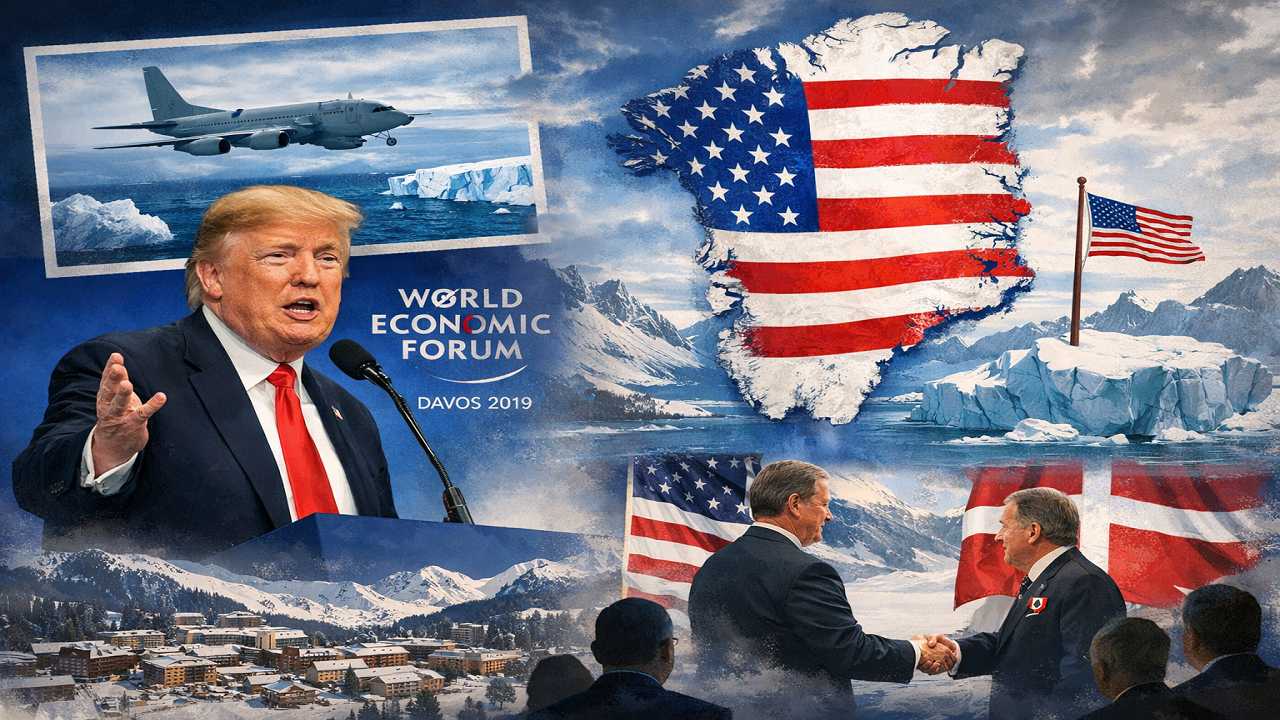
TT – Donald Trump’s appearance at the World Economic Forum in Davos once again proved his unmatched ability to dominate the global conversation. While Davos is traditionally a venue for measured speeches on economics, climate, and cooperation, Trump used the platform to project power politics — placing the Arctic island of Greenland at the center of a renewed geopolitical debate.
What followed was a mix of bold rhetoric, diplomatic tension, partial de-escalation, and lingering uncertainty — a reminder that Greenland, long seen as remote and peripheral, has become strategically central in a rapidly changing world.
📍 1. Trump’s 2026 Davos Trip — Context & Key Messages
In late January 2026, former U.S. President Donald Trump made a high-profile appearance at the World Economic Forum (WEF) in Davos, Switzerland — his first major international forum of the year. Trump described his trip as “incredible,” using the platform to address global leaders, business elites, and media about U.S. strategic priorities, from economic performance and national defense to alliances and security initiatives.
In his remarks, Trump emphasized American economic strength and geopolitical leadership, blending domestic policy pride with hard-edged diplomatic rhetoric. While he spoke on multiple topics — including the Middle East — the issue dominating both global headlines and transatlantic diplomacy was Greenland.
🧊 2. The Greenland Controversy: From Escalation to “Framework”
One of the most dramatic narratives of Trump’s Davos appearance was his persistence in pushing for an agreement over Greenland, the vast Arctic island that is a semi-autonomous part of the Kingdom of Denmark.
🟡 Initial Tensions
Earlier in January 2026, Trump intensified his public demand for U.S. access to Greenland, framing it as a matter of strategic necessity amid global competition, especially with Russia and China. This demand, uncommon in modern diplomatic discourse, raised eyebrows because:
- Greenland is sovereign Danish territory with its own local government;
- Both Greenland and Denmark repeatedly stated the island was not for sale and not open to transfer to the U.S. or any third party; and
- Trump’s rhetoric included economic and military pressure, including threatened tariffs on European nations that opposed U.S. ambitions — a move that risked severe consequences for transatlantic trade relations.
His confrontational tone sparked significant concern among NATO allies, diplomats, and even members of his own party who worried about diplomatic repercussions and alliance strain.
🤝 De-Escalation at Davos: The “Framework of a Future Deal”
At Davos, after a high-stakes meeting with NATO Secretary General Mark Rutte, Trump publicly announced that he had reached a “framework of a future deal” regarding Greenland and broader Arctic cooperation. In doing so, he backed off from imminent threats of tariffs on European allies that had opposed U.S. pressure tactics.
📌 What Trump Claimed
Trump said:
- He was withdrawing tariff threats previously scheduled for February 1, 2026.
- Negotiations had produced the basis — a framework — for a future agreement that his administration sees as beneficial for the U.S. and NATO allies.
- The proposed framework could involve expanded cooperation in the Arctic, including military and strategic projects like the Golden Dome missile defense system — though details are still very vague.
Importantly, Trump also explicitly ruled out using military force to take Greenland, a reassurance meant to calm fears of an outright territorial grab.
🆚 European & Greenlandic Responses
While Trump celebrated the formation of a framework, leaders in Copenhagen and Nuuk (Greenland’s capital) were cautious or outright dismissive:
- Greenland’s Prime Minister Jens-Frederik Nielsen stressed that no actual deal exists yet and that Greenland’s sovereignty must be respected in any negotiations.
- Danish officials also reiterated that territorial transfer is a non-negotiable “red line” and that any future talks would focus on cooperation — not ownership.
- The European Union indicated concern over past U.S. tariff threats and signaled it may pursue stabilization of economic relations and strategic autonomy in response.
At the diplomatic level, NATO Secretary General Rutte described the talks as positive but emphasized that “there’s still a lot of work to be done” on any concrete agreement, underscoring the early and tentative nature of the framework.
🧠 Wider Implications: Politics, Markets, and Strategic Autonomy
The Greenland saga generated ripple effects beyond Davos:
📈 Markets
Financial markets reacted strongly when the initial Greenland tensions escalated, with global equities dipping amid fears of trade disruptions. Once Trump announced the tariff withdrawal and future framework, U.S. stocks rebounded.
🪖 NATO and Transatlantic Ties
Many analysts see the episode as emblematic of deeper strains within the U.S.–European alliance — not just over Arctic geopolitics but over how leverage and economic pressure are used within those relationships. Some commentators argue that the affair will spur Europe to pursue strategic autonomy more vigorously.
😡 Public Backlash & Cultural Reaction
Across Denmark and Greenland, large protests erupted under slogans like “Greenland is not for sale,” reflecting broad public opposition to U.S. pressure.
📌 Conclusion: What This Means Going Forward
The Davos episode and the Greenland issue reflect a complex blend of American political theater, strategic competition in the Arctic, and evolving alliance dynamics:
- Trump recalibrated his approach at Davos — moving from overt threats to diplomatic frameworks and dropping tariffs that could have ignited trade conflict.
- Actual negotiations remain ongoing and undefined. Greenland and Denmark insist their sovereignty cannot be compromised.
- The controversy has exposed vulnerabilities and tensions in transatlantic relations at a time when NATO unity is critical amid competition with China and Russia.
- Public opinion in Europe and Greenland remains skeptical or hostile to U.S. territorial ambitions, underscoring that even high-level diplomatic frameworks must reckon with domestic sentiments.
Key takeaway: While outright acquisition of Greenland is off the table for now, the Arctic has become a central arena for geopolitical competition, and the U.S. — under Trump — is signaling it won’t back away from asserting influence, even at the cost of alliance friction.