

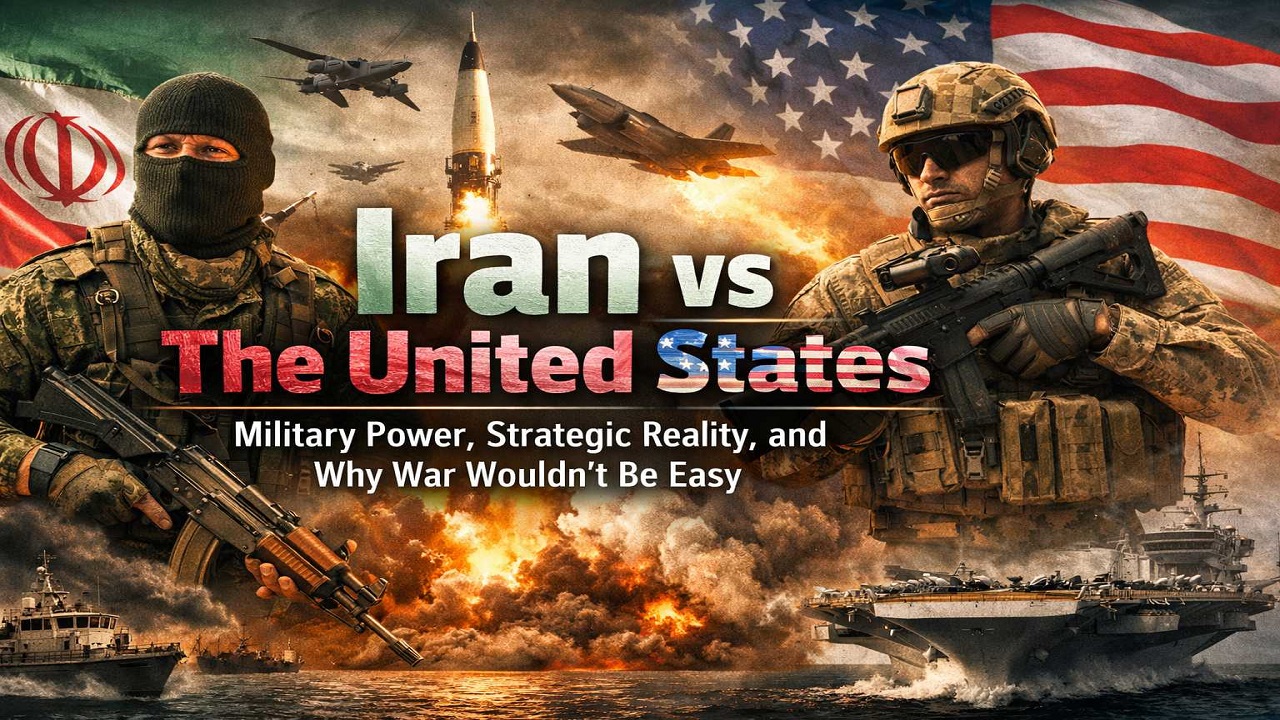
TT – Tensions between the United States and Iran have shaped Middle Eastern geopolitics for decades, often raising the same question whenever crises flare: How powerful is Iran militarily, and how difficult would it really be for the United States to fight a war against it? On paper, the comparison appears lopsided. The U.S. commands the world’s largest defense budget, unmatched air and naval power, and a global military presence. Iran, by contrast, operates with far fewer resources and largely outdated conventional platforms.
Yet military power is not measured by numbers alone. Iran has spent decades adapting to its disadvantages by developing a strategy built around missiles, drones, proxy forces, and asymmetric warfare — tools designed not to defeat the United States outright, but to impose costs, complicate decision-making, and deter direct confrontation. This strategic reality means that while the U.S. could dominate Iran in a conventional fight, translating that dominance into a quick, clean, and contained war is far from guaranteed.
This article breaks down Iran’s military capabilities, compares them directly with those of the United States, and explores what different conflict scenarios might look like — from limited strikes to full-scale war. Rather than asking who would “win,” the goal is to understand why a conflict between these two powers would be less straightforward, more dangerous, and more consequential than it may first appear.
Iran’s Military Power: An Overview
1. Structure of Iran’s Armed Forces
Iran’s military is divided into several major components:
- The Regular Military (Artesh): Conventional army, air force, navy, and air defense units responsible for territorial defense.
- Islamic Revolutionary Guard Corps (IRGC): A powerful, ideologically driven force with its own ground, aerospace, naval, and cyber branches. The IRGC also oversees the Quds Force (external operations) and the Basij militia.
- Basij Paramilitary: A reserve force with large membership, used mainly for internal security and guerrilla-style operations.
This mixture reflects Iran’s emphasis on asymmetric warfare — using unconventional methods and proxy networks rather than traditional massed conventional forces.
2. Quantitative Comparison with the United States
The contrast between Iran and the United States in military capacity is stark:
Defense Budget
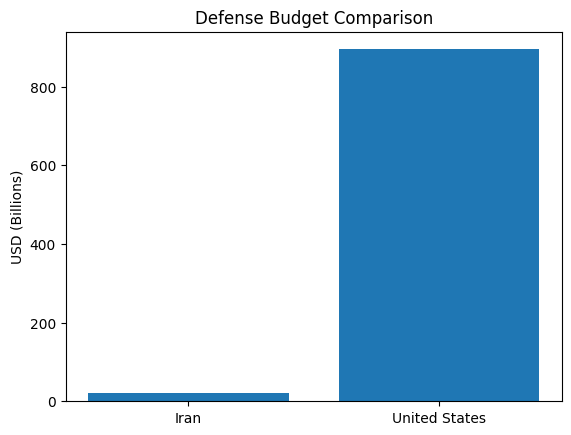
Shows the enormous disparity between U.S. and Iranian military spending.
Useful to illustrate why the U.S. maintains technological, logistical, and global-reach superiority.
- United States: Around $895 billion (2026 estimate).
- Iran: Roughly $15–24 billion, even after significant increases.
This means the U.S. defense budget is ~60 times larger than Iran’s, giving Washington vast advantages in advanced weaponry, R&D, and force sustainment.
Personnel
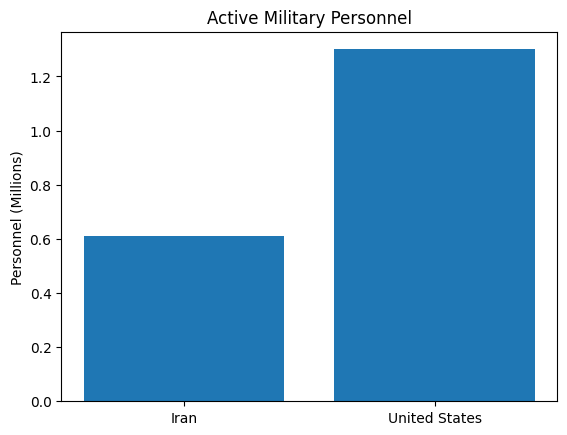
Highlights that while Iran has a sizable force, the U.S. still fields a larger and far better-resourced active military.
This chart helps explain why Iran relies more on asymmetric and proxy warfare.
- U.S. Active Forces: ~1.3 million.
- Iran Active Forces: ~600–610 thousand (plus hundreds of thousands in IRGC and reserves).
Air Power
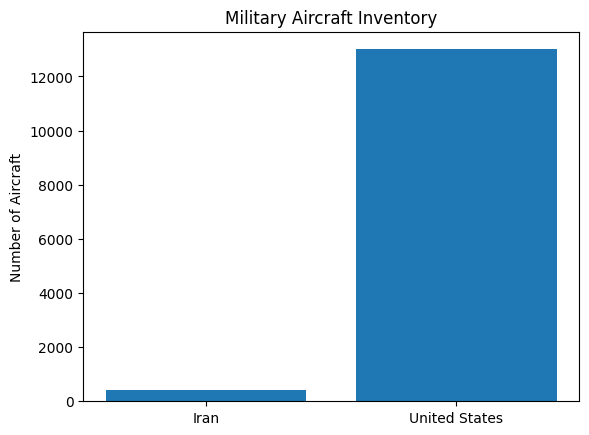
Demonstrates one of the starkest capability gaps.
The U.S. advantage in airpower is decisive for any conventional conflict scenario.
- United States: ~13,000 aircraft including fifth-generation fighters (F-35s, F-22s), aerial refuelers, bombers, and drones.
- Iran: ~350–500 aircraft. Many are older models or domestically produced with limited capabilities.
Naval Strength
| Country | Aircraft Carriers |
|---|---|
| Iran | 0 |
| United States | 11 |
Aircraft carriers are the backbone of global naval power. Iran has none; the U.S. operates 11 nuclear-powered carriers.
| Country | Submarines |
|---|---|
| Iran | ~25 |
| United States | ~68 |
Iran’s submarines are designed for regional disruption; U.S. submarines are built for global dominance.
| Country | Ships |
|---|---|
| Iran | ~15 |
| United States | ~120 |
The U.S. Navy maintains overwhelming superiority in blue-water surface combat.
- U.S. Navy: Globally dominant, with aircraft carriers, destroyers, cruisers, and nuclear submarines able to project power worldwide.
- Iran: Primarily regional naval forces focused on the Persian Gulf and Strait of Hormuz, with smaller vessels and submarines suited to coastal defense.
- Iran’s submarines: mostly diesel-electric, coastal
- U.S. submarines: nuclear-powered, global strike capable
Missiles and Drones
- Iran has thousands of ballistic missiles with ranges sufficient to reach targets across the Middle East. Its drone industry — especially loitering munitions — has evolved rapidly, used both by Iranian forces and proxies abroad.
Overall, while Iran is a significant regional military power, it is not close to matching the United States in state-on-state conventional warfare capabilities.
3. Asymmetric Strengths: What Iran Can Do
Despite conventional limitations, Iran’s military strengths lie in areas designed to deter and complicate direct confrontation:
Missile Arsenal
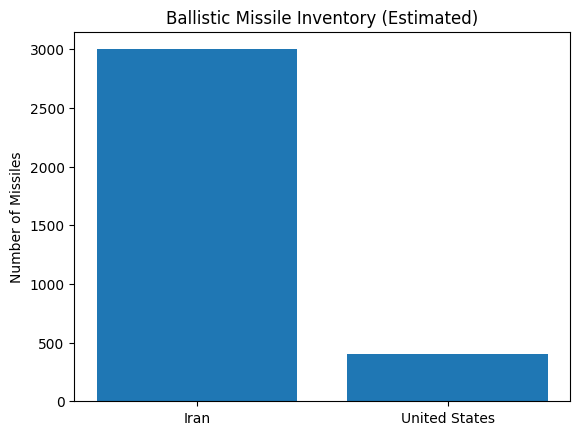
Ballistic Missiles: Iran’s missile inventory is far larger than the U.S.’s because missiles are Iran’s primary deterrent and strike tool.
Iran possesses a large and diverse missile inventory, including mobile launchers and medium-range ballistic missiles. These systems serve as a key deterrent and threat against regional targets.
Drones and Unmanned Systems
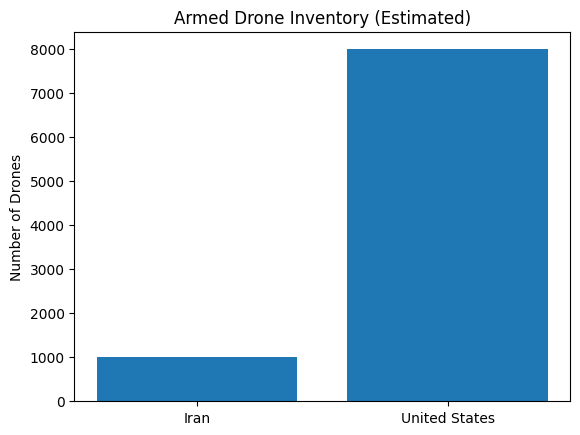
Armed Drones: The U.S. dominates in drone quantity, quality, endurance, and global deployment.
Iran compensates for weak airpower with missiles, while the U.S. relies on aircraft and drones for precision global strikes.
Iran’s UAVs vary from reconnaissance drones to suicide loitering munitions, used effectively by Iranian forces and proxies like Hezbollah and the Houthis.
Electronic/Cyber Warfare
Iran has invested in jamming and cyber units capable of disrupting surveillance and communications — though these remain less advanced than U.S. systems.
Proxy Networks
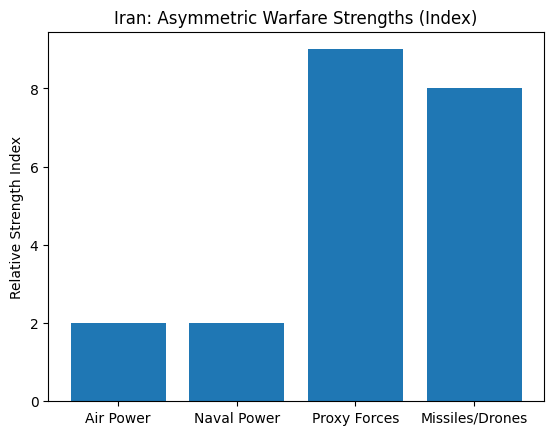
Perhaps Iran’s most potent asymmetric tool is its network of proxies and allied militias across the Middle East. These groups can strike U.S. partners and interests without direct Iranian troop deployment, complicating retaliation calculus.
4. U.S. Military Power: Conventional Dominance
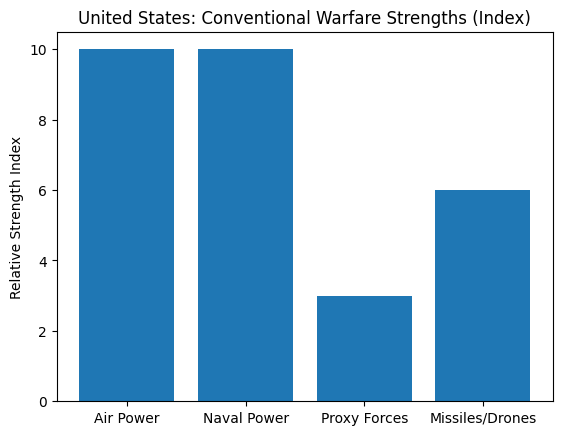
The U.S. remains the world’s most technologically advanced and logistically capable military:
Global Reach
The United States operates military bases around the world and can project power via carrier strike groups, long-range bombers, and aerial refueling assets that can sustain long campaigns without reliance on local basing.
Precision Strike Capability
Advanced platforms like the F-35, B-2 bombers, and Tomahawk cruise missiles allow the U.S. to strike deep into hostile territory with high accuracy and at long range — a capability demonstrated in real exercises and operations.
Nuclear Arsenal
The U.S. possesses thousands of nuclear warheads and delivery systems, forming the ultimate strategic deterrent. In contrast, Iran does not currently have a known nuclear weapons arsenal.
Allied Support
The U.S. fights in close coordination with NATO allies and regional partners, adding to its operational depth and interoperability.
5. Challenges and Limitations of Military Engagement
Despite the overwhelming asymmetry in favor of the U.S., military engagement with Iran is far from “easy”:
A. Geographic and Strategic Issues
Iran’s terrain — including mountainous regions and deep-buried facilities — complicates targeting. Strategic sites are often dispersed and hardened, increasing the difficulty and cost of comprehensive strikes.
B. Asymmetric Retaliation
Iran does not need to defeat U.S. forces conventionally to impose costs. Its missile and drone capabilities can force expensive and protracted defense responses from U.S. forces and allies.
C. Regional Escalation Risks
An attack on Iran could trigger reprisals from its proxies across Iraq, Syria, Yemen, and Lebanon, leading to multi-front conflicts affecting U.S. forces and partners.
D. Economic and Political Fallout
Disruption of the Strait of Hormuz — through which a substantial portion of global oil exports flows — could have widespread economic repercussions and global energy price spikes.
E. Civilian Casualties and Diplomatic Backlash
Large-scale military action almost invariably leads to civilian harm and humanitarian crises, drawing international condemnation and complicating long-term strategic goals.
6. What a U.S. Military Engagement Might Look Like
If Washington chose a military campaign against Iran, current assessments suggest several phases:
- Initial Precision Strikes: Targeting air defenses, nuclear facilities, and command-and-control sites with long-range missiles and stealth aircraft to degrade Iran’s ability to respond.
- Suppression of Missile and Drone Threats: Focused efforts to intercept or destroy mobile launchers and drone hubs.
- Containment of Proxy Forces: Operations against Iranian-linked militias in neighboring states to prevent broad regional escalation.
- Maritime Security Operations: Ensuring freedom of navigation in critical chokepoints like the Strait of Hormuz.
Even this type of campaign requires extensive planning, intelligence, and diplomatic coordination, highlighting that military action would not be simple or cost-free.
7. Conclusion
Iran’s military strength is significant within its region and particularly in asymmetric domains like missiles, drones, and proxy warfare. Yet, in conventional power projection, Iran lags far behind the United States, especially in budget, technology, and global reach.
A U.S. military engagement would likely achieve specific tactical objectives — such as degrading strategic facilities — but would not be “easy.” The challenges of retaliation, regional destabilization, economic consequences, and long-term occupation or enforcement would shape any conflict and make it a complex, risky undertaking.
Rather than simply relying on military superiority, both sides have historically used deterrence, diplomacy, sanctions, and indirect competition — reflecting the profound risks inherent in direct warfare.