

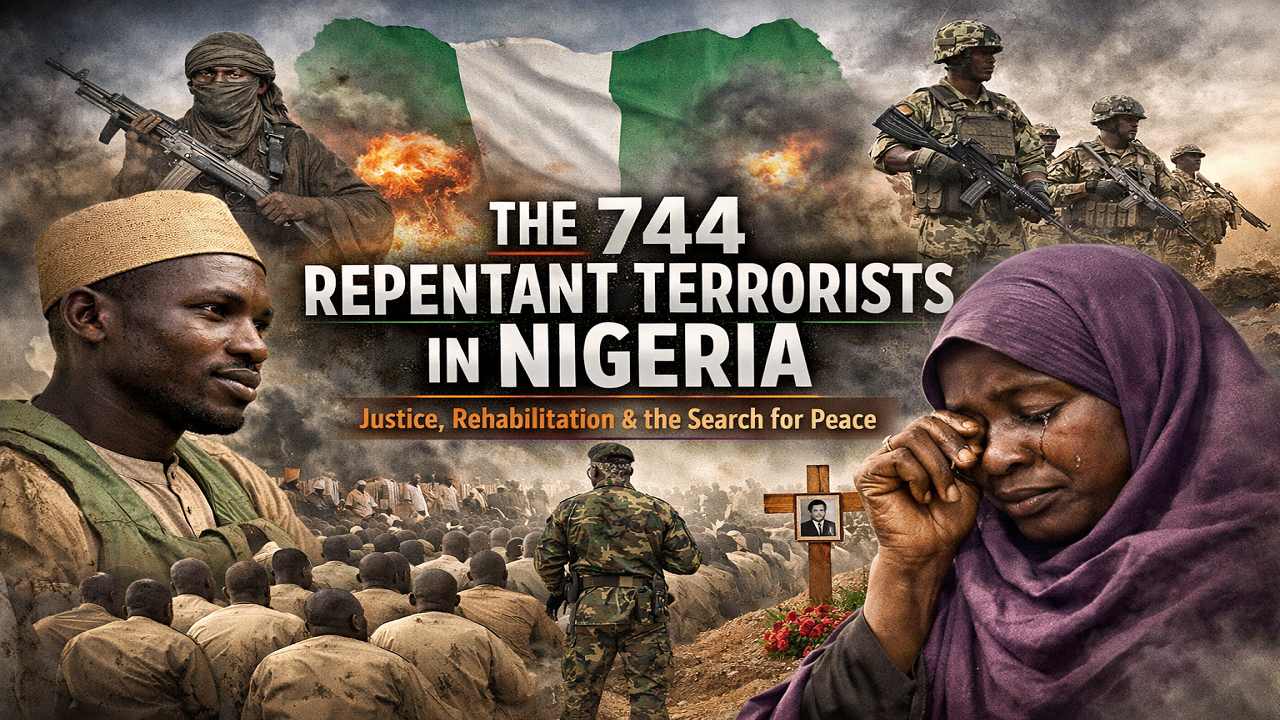
Nigeria’s decision to reintegrate 744 repentant terrorists has sparked a national debate—balancing justice for victims with the urgent need for lasting peace. Is this a bold strategy to end insurgency, or a risky gamble with public safety?
In April 2026, the Nigerian government announced that 744 former terrorists had completed a rehabilitation programme and were ready to be reintegrated into society.
The development immediately sparked intense debate across Nigeria and beyond. For some, it represents a pragmatic step toward ending a brutal insurgency. For others, it raises uncomfortable questions about justice, accountability, and the safety of communities that have suffered for over a decade.
This is not just a security story—it is a deeply human, political, and moral dilemma.
Understanding the Context: Nigeria’s Long War Against Terrorism
Nigeria has been battling Islamist insurgency—primarily driven by groups like Boko Haram and its offshoot ISWAP—for over 15 years. The conflict has:
- Killed tens of thousands
- Displaced millions
- Devastated entire communities, especially in the northeast
Even in 2026, the violence continues. For instance, recent attacks and military operations still result in high casualties and controversy, highlighting how far the country is from achieving lasting peace.
Against this backdrop, the idea of rehabilitating former fighters emerges not as a luxury—but as a strategy.

What Is Operation Safe Corridor?
The 744 individuals are graduates of Nigeria’s De-radicalisation, Rehabilitation and Reintegration (DRR) programme, popularly known as Operation Safe Corridor.
This initiative was designed as a non-military approach to complement ongoing military operations.
Participants in the programme undergo:
- Psychological counseling
- Religious reorientation
- Vocational and educational training
- Civic and behavioral reform
According to officials, the aim is not to reward terrorism but to break the cycle of violence.
As one military authority emphasized, the programme is:
“not a sign of weakness… but a deliberate strategy to reduce violence.”
Who Are the 744?
The group is not uniform, and this is a crucial detail often lost in public discourse.
Among the 744 are:
- Former Boko Haram fighters
- Individuals coerced into joining extremist groups
- Victims of abduction and manipulation
- People linked to insurgency in varying degrees
Geographically, the majority come from Borno State (597 individuals)—the epicenter of the insurgency—while others are drawn from multiple states across Nigeria.
This diversity complicates the narrative: not all are hardened militants; some are themselves victims of terrorism.
Why Is Nigeria Doing This?
At first glance, reintegrating former terrorists into society may seem counterintuitive. But from a strategic standpoint, the government’s reasoning rests on several key pillars:
1. Military Victory Alone Is Not Enough
Despite years of military campaigns, insurgency persists. Extremist groups continuously recruit, adapt, and regroup.
2. Breaking Recruitment Cycles
Rehabilitation reduces the pool of active fighters and undermines extremist propaganda.
3. Intelligence and Defections
Encouraging defections can weaken insurgent networks from within.
4. Cost of Endless War
Sustained military operations are expensive, both financially and in human lives.
In essence, Nigeria is attempting a hybrid strategy: combining force with reconciliation.
Public Outrage and Ethical Questions
The announcement has triggered widespread criticism, particularly among:
- Victims of terrorist attacks
- Families of fallen soldiers
- Civil society groups
The central question is simple but powerful:
How can those who committed violence be reintegrated while victims are still grieving?
Critics argue that:
- Justice appears sidelined
- Reintegration may endanger communities
- The programme lacks transparency
Some fear that without proper monitoring, recidivism (return to violence) could occur.

The Justice vs Peace Dilemma
At the heart of the debate lies a classic post-conflict dilemma:
| Justice | Peace |
|---|---|
| Punish perpetrators | Reintegrate offenders |
| Provide closure to victims | Prevent future violence |
| Uphold rule of law | Promote reconciliation |
Nigeria is attempting to balance both—but not everyone agrees with where the balance lies.
Community Reintegration: The Hardest Part
Graduation from the programme is only the beginning. The real challenge is acceptance at the community level.
Reintegration requires:
- Community trust
- Monitoring systems
- Economic opportunities
- Social support
Officials have stressed that success depends heavily on local communities being willing to accept returnees.
But in areas where people have lost family members, homes, and livelihoods, forgiveness is far from guaranteed.
Risks and Potential Consequences
While the programme has clear intentions, it carries significant risks:
1. Security Risks
If even a small number return to extremist activity, the consequences could be severe.
2. Social Tension
Communities may resist reintegration, leading to conflict or stigmatization.
3. Political Backlash
Public anger can erode trust in government institutions.
4. Moral Hazard
Some fear it could unintentionally signal that violence has limited consequences.
The Case for Rehabilitation
Despite the controversy, there are strong arguments in favor of the initiative:
- Many participants were not voluntary recruits
- Long-term peace requires addressing ideology, not just fighters
- Similar programmes in other countries have shown mixed but sometimes positive results
- Endless incarceration or execution is not always sustainable or effective
In conflict resolution theory, reintegration is often seen as essential to post-war stabilization.
A Broader Pattern in Counterterrorism
Nigeria is not alone in adopting such measures. Around the world, countries facing insurgencies have experimented with:
- Amnesty programmes
- Reintegration initiatives
- De-radicalisation efforts
The results are often controversial—but they reflect a growing recognition that terrorism is not just a military problem, but also a social and ideological one.

Conclusion: A Necessary Risk or a Dangerous Gamble?
The reintegration of 744 repentant terrorists is one of the most controversial security decisions Nigeria has made in recent years.
It forces the country—and the world—to confront difficult questions:
- Can people who once embraced violence truly change?
- Should forgiveness be part of national security strategy?
- How do you balance justice for victims with the need for peace?
There are no easy answers.
What is clear, however, is that Nigeria is experimenting with a path that prioritizes long-term stability over immediate retribution. Whether this approach succeeds or fails will depend not just on government policy—but on communities, accountability systems, and the sincerity of those being given a second chance.