
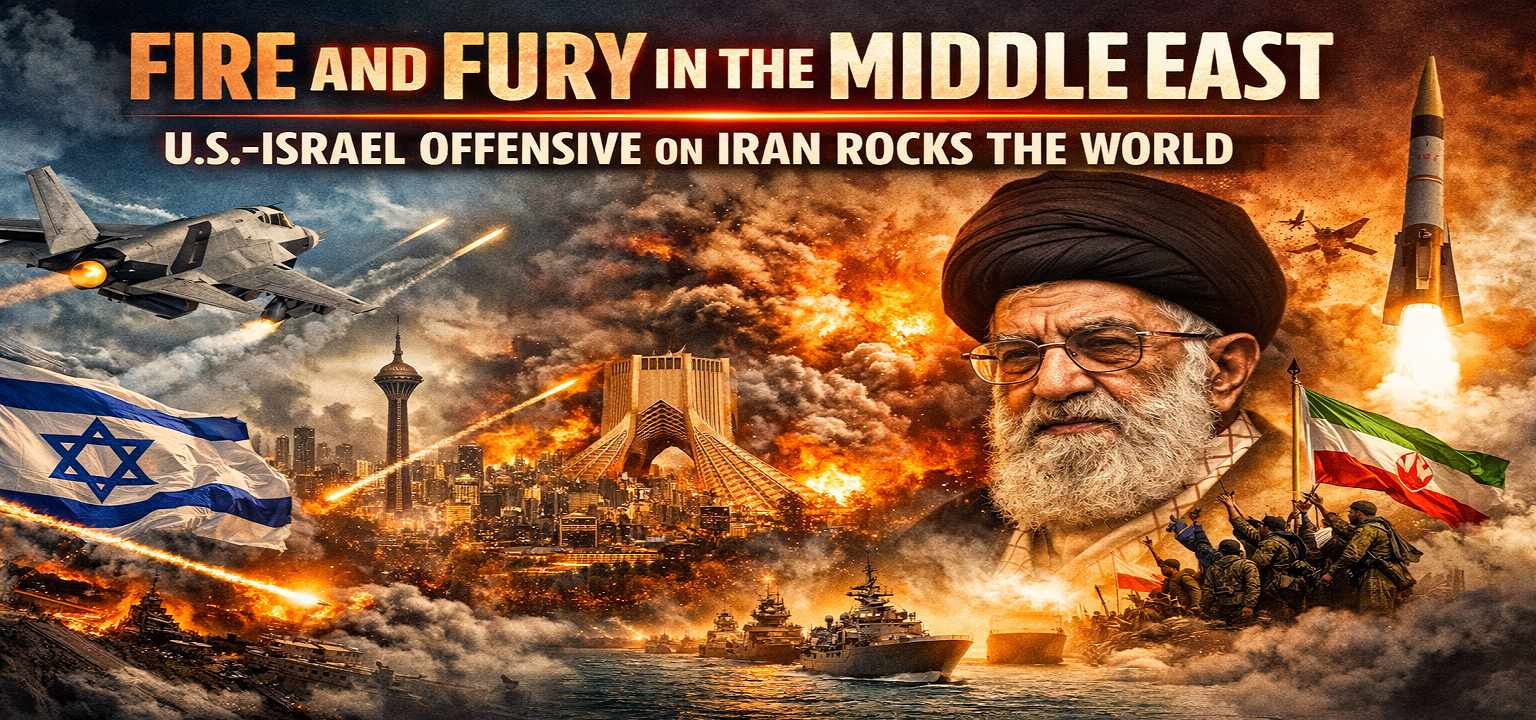
In late February 2026, a dramatic escalation in the Middle East erupted into a full-scale conflict involving the United States, Israel, and Iran. Long-standing tensions over Iran’s nuclear ambitions, regional proxy influence, ballistic missile development, and deep distrust boiled over into open war, marking one of the most significant regional confrontations in decades.
The military campaign — dubbed Operation Epic Fury (in U.S. discourse) and Operation Lion’s Roar (in Israeli sources) — was launched on February 28, 2026 by Israel with substantial U.S. participation. Its declared aim was to degrade Iran’s military capabilities, eliminate nuclear threats, and undermine Tehran’s regional influence.
🚀 Key Military Developments
- Joint Airstrikes Across Iran: Israeli and U.S. forces conducted an intensive air and missile bombardment on Iranian military infrastructure, missile sites, command centers, and strategic facilities — including reports of strikes on government buildings in Tehran.
- Death of Iran’s Supreme Leader: Iranian Supreme Leader Ayatollah Ali Khamenei was reported killed in the initial surge of attacks, a pivotal moment that transformed tensions into outright war.
- Air Superiority: As of early March, Israeli and U.S. forces claimed control of much of Iranian airspace, projecting their dominance while acknowledging remaining hidden missile systems in underground bunkers.
- Immediate Retaliation: Iran responded with waves of missiles, drones, and attacks on U.S. and allied targets across the Gulf, including assets in Kuwait, Qatar, UAE, and Saudi Arabia — prompting airspace closures and striking global aviation networks.
🧨 Human and Material Costs

Estimates from multiple sources point to a rapid rise in casualties just days into the conflict:
📍 Iran: Several hundred to over 700 killed in strikes and explosions across many cities, with thousands wounded.
📍 Israel & Allied States: Iranian missile and drone strikes resulted in casualties inside Israel as well as in Gulf nations hosting U.S. assets.
📍 U.S. Forces: At least half a dozen U.S. service members have been confirmed killed, alongside material losses.
With airspace closures, major disruptions to commercial flights, and heightened military activity, the conflict’s toll continues to mount. Analysts warn that these early casualty figures likely understate the eventual human and economic cost.
🌍 Regional Expansion and International Spillover
- Proxy and Allied Involvement: Iran-aligned groups such as Hezbollah in Lebanon have launched missiles into Israel, triggering Israeli retaliatory strikes within Lebanon.
- Gulf State Tensions: Iran’s retaliation against U.S. and allied interests in the Gulf has drawn several countries into a security crisis, with missile strikes and diplomatic strain across the region.
- Strait of Hormuz Crisis: Iran’s threats and missile activity have disrupted operations near the crucial Strait of Hormuz, a chokepoint for global oil shipments, raising energy market volatility and geopolitical risk.
- European Involvement: Countries like France moved to secure defensive positions and protect regional partners, even as they called for diplomacy and expressed reservations about international law violations.
📉 Global Political and Economic Impact
The escalation has reverberated far beyond the Middle East:
- Energy Markets: Fears of supply disruption have pushed crude prices higher and triggered insurance and shipment risks tied to the Strait of Hormuz.
- Air Travel: Major airline routes above the Middle East were suspended, causing broad cancellations and rerouting.
- Stock Markets & Financial Stability: Regional stock markets saw downturns, with fear premiums rising on risk assets.
🌐 Global Reaction & Condemnation
International responses differ starkly:
📍 Global South and Developing Nations: Many countries — including China, South Africa, Brazil, Turkey, and others — condemned the U.S.-Israel offensive as illegal, imperialist, and counterproductive to peace.
📍 Western Powers: European states have emphasized diplomatic solutions and international law, balancing calls for restraint with acknowledgment of security concerns.
📍 United Nations: Emergency sessions have been convened to address the rapidly escalating conflict and civilian safety concerns.
⚖️ Why This Escalation Happened
The origins of this war lie in decades of animosity between Israel and Iran, particularly over Tehran’s nuclear ambitions, proxy groups, and regional influence. Diplomatic talks earlier in 2026 aimed to stave off conflict but collapsed, leading to a pre-emptive military strategy from Israel, backed by U.S. military planning.
U.S. officials have suggested that their intervention was motivated by an imminent threat and the belief that Iranian capabilities posed immediate dangers to regional stability, while also hoping the conflict could catalyze internal change in Iran.

🔮 What Comes Next?
Experts see several possible trajectories:
📌 A protracted air and missile campaign, with no clear end in sight, potentially lasting weeks or months.
📌 Widening regional involvement, with more proxy groups and neighboring states drawn into the conflict.
📌 Diplomatic backchannels, under intense pressure, seeking ceasefire or negotiated disengagement.
📌 Global polarization, with countries aligning more strongly with either the U.S.-Israel bloc or Iran and its sympathizers.

🧠 Conclusion
The US-Israel war with Iran has shattered expectations of a contained skirmish. Instead, it has unleashed an intense regional confrontation with deep human suffering, strategic geopolitical shifts, and broad global consequences. The conflict challenges traditional security frameworks and may redefine power dynamics in the Middle East for years to come.