

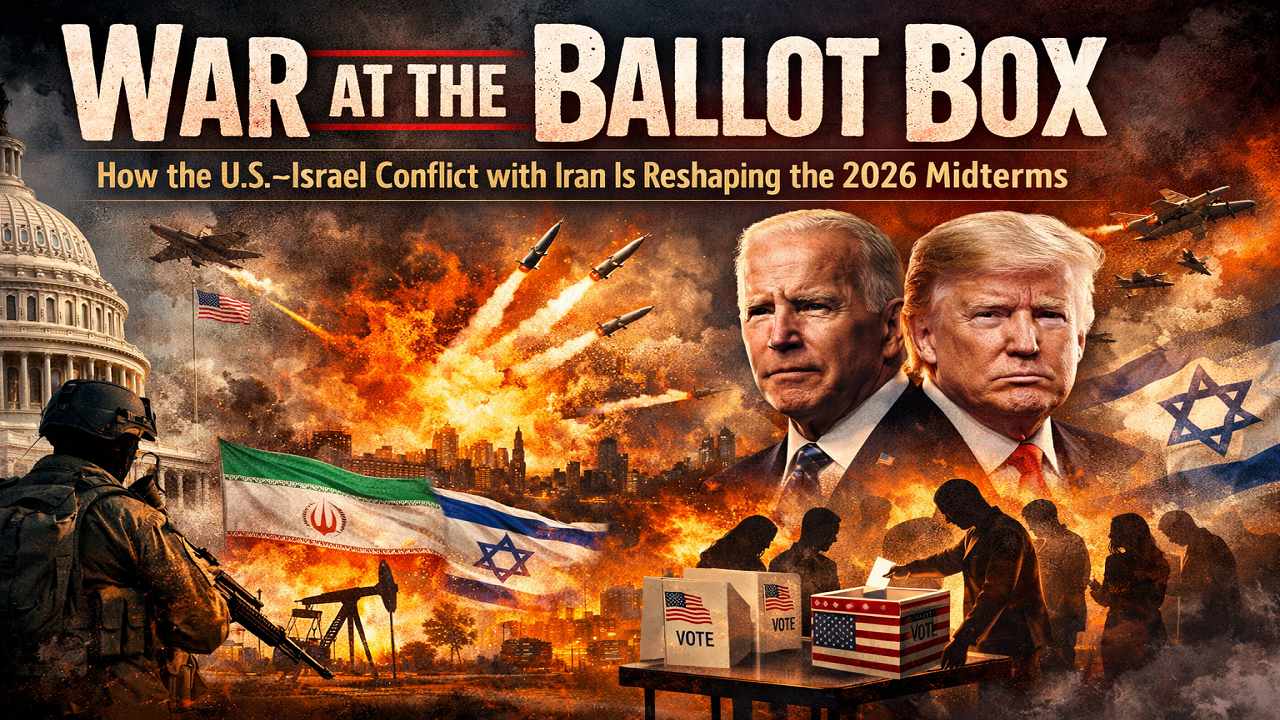
As the 2026 U.S. mid-term election cycle intensifies, an unexpected and dramatic factor now looms large over Washington’s political landscape: a full-scale military escalation involving the United States, Israel, and Iran. What began as rising diplomatic tensions over Iran’s nuclear program and regional behavior has unleashed a crisis whose reverberations — from Congress to Main Street — could redefine American politics this fall.
📌 The Flashpoint: The U.S.–Israel War with Iran
On February 28, 2026, the U.S. and Israel launched an unprecedented joint military operation deep into Iranian territory, widely referred to by analysts as a pivotal escalation in Middle Eastern hostilities. The offensive targeted strategic military infrastructure — including Iran’s ballistic missile systems — and reportedly killed Supreme Leader Ayatollah Ali Khamenei, a stunning blow to Tehran’s political hierarchy.
Iran’s retaliation has been swift and multifaceted. Missile and drone strikes have targeted U.S. bases and allies across the Gulf, and allied militia groups such as Hezbollah have resumed attacks against Israel. The conflict risks expanding beyond a bilateral confrontation into a broader regional war.

⚖️ Domestic Political Fallout: A Nation Divided
1. GOP Under Strain
Conservative ranks are visibly fraying. Traditionally reliable Republican support for foreign military action is being tested as dissent grows over the war’s rationale and cost. Some Republicans publicly blame Israel’s strategic aims for dragging the U.S. into conflict — a divisive narrative that complicates unity ahead of critical election battles.
2. Democratic Party Crossroads
The war has also exposed fissures within the Democratic Party. While leadership has largely criticized the Trump administration’s handling of the conflict and demanded clearer justifications and oversight, not all Democrats agree on strategy. Some back more robust action; others see the war as unconstitutional and electorally perilous.
3. Voter Sentiment Shifts
Polls indicate majority disapproval among Americans over U.S. engagement in Iran — with only around one in four approving of the strikes. Rising costs of living, particularly gasoline prices, are contributing to voter discontent.
💰 Economic Impact: Fuel, Inflation, and Everyday Costs
The geopolitical upheaval has quickly translated into economic pressure at home:
- Gasoline and oil prices spiked sharply, reversing months of decline and straining household budgets.
- The Federal Reserve faces renewed uncertainty, with inflationary pressures complicating monetary policy decisions — especially in a pre-election economy already grappling with slow wage growth and uneven consumer confidence.
For many voters, the war’s economic consequences — particularly rising petrol prices — are not abstract geopolitical data points, but everyday burdens that could influence their ballots.

🌍 Geopolitical Repercussions Beyond U.S. Borders
The conflict has drawn sharp international attention:
- Nations across the Global South have condemned the U.S.–Israeli offensive, framing it as a violation of international norms.
- Major global energy flows — especially through the Strait of Hormuz — have been disrupted, triggering market volatility that affects import-dependent economies.
- Traditional U.S. allies are publicly uneasy, while global powers like Russia, China, and Turkey critique Washington’s strategy.
These developments underscore that the mid-term electoral calculus isn’t just about domestic politics — it’s also about how U.S. global leadership is perceived across regions and alliances.
🗳️ Strategic Implications for the Midterms
With primary races already underway, races that could determine control of Congress are tightening. For instance:
- In Texas and North Carolina, tight Senate battles are emerging between entrenched GOP figures and competitive Democratic challengers.
Against this backdrop, the war’s popularity — or lack thereof — could have decisive effects, especially in swing constituencies. Candidates on both sides are recalibrating their messaging to respond to voter anxiety about war, economic pressures, and national security priorities.
🧠 The Bigger Picture: Long-Term Polarization and Foreign Policy Debate
This election cycle may mark a structural realignment:
- Foreign policy is no longer a bipartisan stabilizer but a potential flashpoint.
- Voters increasingly question longstanding U.S. alliances and the human and economic cost of intervention.
- Emerging anti-war factions within both major parties could reshape future American strategy and priorities.
In short, the Iran war is reshaping the political terrain just as voters prepare to decide who will lead and legislate for the next two years.

📌 Conclusion: Elections in Era of Conflict
The U.S. mid-term elections are unfolding against a backdrop of unprecedented geopolitical volatility. What was once largely congressional, economic, and domestic — from infrastructure spending to abortion rights — is now interwoven with a dramatic Middle Eastern conflict that influences voter sentiment, national security debates, economic stability, and global perceptions of American leadership.
In 2026, war and politics are no longer parallel tracks — they are deeply intertwined, and their convergence may be as consequential as any election in recent U.S. history.