

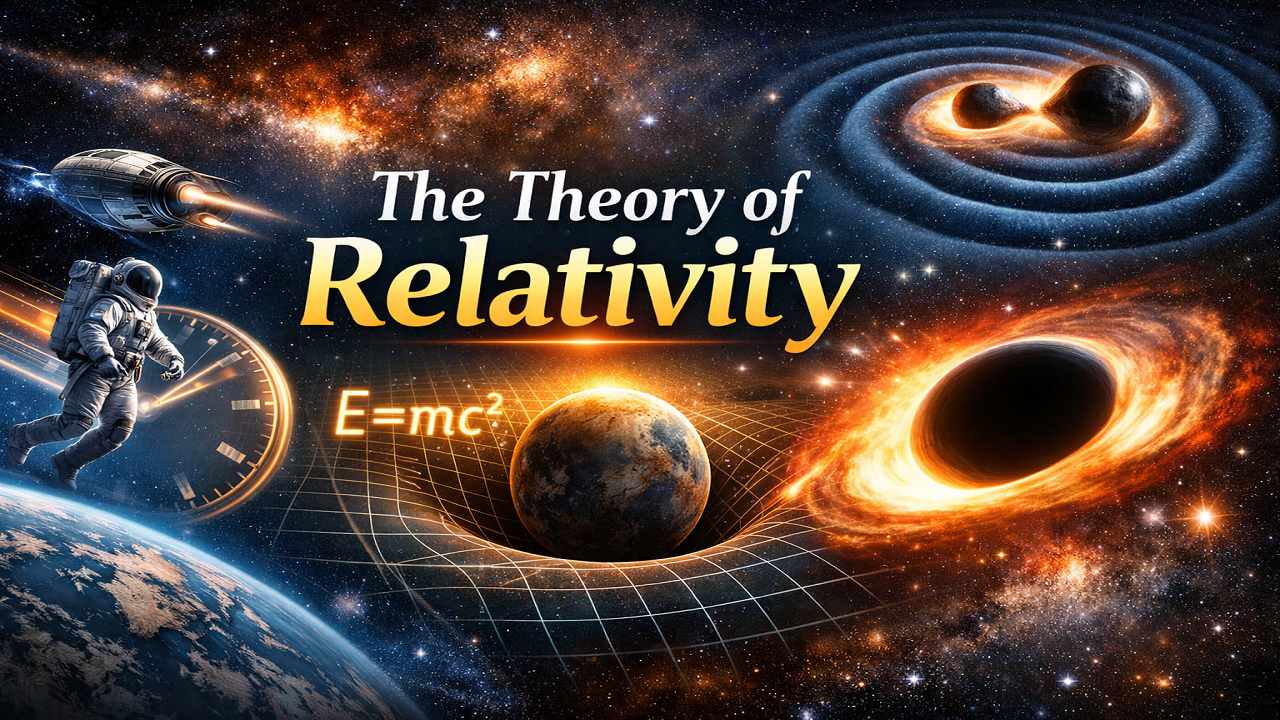
The Theory of Relativity is one of the most important scientific ideas ever developed. Proposed by Albert Einstein in the early 20th century, it fundamentally changed how we understand space, time, gravity, and the universe itself.
Relativity actually consists of two theories:
- Special Relativity (1905)
- General Relativity (1915)
Let’s break them down in a way that builds intuition step by step.

1. Special Relativity: Space and Time Are Not Absolute
Special relativity is based on two simple but powerful ideas:
1. The laws of physics are the same for all observers in uniform motion
2. The speed of light is constant for everyone
No matter how fast you’re moving, if you measure the speed of light in a vacuum, you’ll always get about 299,792,458 meters per second.
This leads to some surprising consequences.
Time Dilation (Time Slows Down)
According to special relativity, time does not flow at the same rate for everyone.
If you travel at speeds close to the speed of light:
- Time moves slower for you compared to someone at rest.
This effect is called Time Dilation.
Example:
Imagine twins:
- One stays on Earth
- The other travels in a fast spaceship
When the traveler returns, they are younger than the twin on Earth. This is known as the twin paradox.
Length Contraction (Objects Shrink)
Objects moving at very high speeds appear shorter in the direction of motion. This is called Length Contraction.
Mass-Energy Equivalence
Perhaps the most famous equation in physics:E=mc2
This equation shows that:
- Mass and energy are interchangeable
- A small amount of mass can produce a huge amount of energy
This idea underlies nuclear energy and atomic weapons.
2. General Relativity: Gravity Is Geometry
While special relativity deals with motion at constant speeds, general relativity explains gravity.
Einstein’s key insight:
Gravity is not a force—it’s the bending of spacetime.
Spacetime: A Unified Fabric
Einstein combined space and time into a single concept called Spacetime.
Think of spacetime like a stretchy fabric:
- Massive objects (like planets and stars) bend it
- Other objects move along those curves
Gravity as Curvature
Instead of pulling objects, gravity happens because:
- Objects follow the curved paths in spacetime
A helpful analogy:
- A heavy ball placed on a trampoline bends it
- Smaller balls roll toward it, not because of a force, but because of the curvature
Gravitational Time Dilation
Gravity also affects time.
Closer to a massive object:
- Time runs slower
This is called Gravitational Time Dilation.
Real-world example:
- GPS satellites must correct for this effect, or navigation systems would fail.
Black Holes and Extreme Gravity
General relativity predicts Black Holes:
- Regions where gravity is so strong that nothing—not even light—can escape
At their center lies a singularity, where current physics breaks down.
Gravitational Waves
Einstein also predicted Gravitational Waves:
- Ripples in spacetime caused by massive accelerating objects (like merging black holes)
These were directly detected in 2015, confirming a major prediction of general relativity.
Why Relativity Matters

Relativity isn’t just theoretical—it has real-world applications:
1. GPS Systems
Without relativity corrections:
- GPS errors would accumulate by kilometers each day
2. Astronomy and Cosmology
Relativity helps explain:
- The expansion of the universe
- The behavior of galaxies
- The origin of the cosmos
3. Modern Physics
It forms the foundation for:
- Black hole physics
- Cosmology
- High-energy astrophysics
Key Differences: Special vs General Relativity
| Feature | Special Relativity | General Relativity |
|---|---|---|
| Focus | Motion at constant speed | Gravity and acceleration |
| Key Idea | Speed of light is constant | Gravity = curved spacetime |
| Time | Relative | Affected by gravity |
| Complexity | Simpler | Mathematically complex |
Limitations and Open Questions
Despite its success, relativity is incomplete.
It does not fully align with Quantum Mechanics, which governs the microscopic world.
Physicists are still searching for a theory of quantum gravity that unifies both frameworks.

Conclusion
The theory of relativity revolutionized our understanding of reality by showing that:
- Space and time are flexible, not fixed
- Gravity is geometry, not a force
- The universe is far stranger—and more fascinating—than we once imagined
More than a century later, Einstein’s ideas continue to shape modern science and technology, proving that even the most abstract theories can have profound real-world impact.